On this page
Probability the right way
Sample Space, S
A Sample Space is the set of all possible outcomes of an experiment1. For Example:
- coin flip: S = {Heads, Tails}
- Flipping two coins: S = {(H, H), (H, T), (T, T), (T, H)}
- Roll of 6-sided die: = {1, 2, 3, 4, 5, 6}
- The number of emails you receive in a day: $S = \{x \mid x \in \mathbb{Z}, x \geq 0\}$
Event, E
An Event is some subset of $S$ that we ascribe meaning to2. $E \subseteq S$ in set notation.
- coin flip is heads: E = {Heads}
- At least 1 head on 2 coin flips = {(H, H), (H, T), (T, H)}
- Roll of die is 3 or less: E = {1, 2, 3}
Events can be represented as capital letters such as $E$ or $F$ .
Probability, P(E) or Pr(E) : True Probability
A number between 0 and 1.
\(P(E)\): probability of event \((E)\) occurring.
The ratio of the number of trials in which the event occurs, \(count(Event)\), to the total number of trials performed, $n$. As the number of trials approaches infinity, this ratio converges to the true probability of the event.
\[P(\text{Event}) = \lim_{n \rightarrow \infty} \frac {\text{count}(\text{Event})} {n}\]Axioms of Probability
Axiom 1: $0 ≤ P(E) ≤ 1$ → All probabilities are numbers between 0 and 1.
Axiom 2: $P(S) = 1$ → All outcomes must be from the Sample Space.
Axiom 3: if $E$ and $F$ are mutually exclusive, then $P(E \text{ or } F) = P(E) + P(F)$ → The probability of “or” for mutually exclusive events
These three axioms are formally called the Kolmogorov axioms.
Equally Likely Outcomes
Equally likely outcomes are outcomes that have the same chance (probability) of happening. (In a sample space)
For example, when you toss a fair coin:
- Head → probability = 1/2
- Tail → probability = 1/2
Since both have the same probability, Head and Tail are equally likely outcomes.
Definition: Probability of Equally Likely Outcomes
probability of the sample space must be 1.
If $S$ is a sample space with equally likely outcomes, for an event $E$ that is a subset of the outcomes in $S$:
\[\begin{align} P(E) &= \frac{\text{number of outcomes in $E$}}{\text{number of outcomes in $S$}} = \frac{|E|}{|S|} \end{align}\]Example for Not equally likely outcomes: A bag of balls, Biased coin
- Suppose a bag contains:
- 8 red balls
- 2 blue balls
If you randomly pick one: $P(red) = 0.8$, $P(blue) = 0.2$
- Biased coin: Suppose a coin is designed so that:
- Heads → 70% chance
- Tails → 30% chance They are not equally likely because:$P(H) \ne P(T)$
Probability of or
source3
Calculating the probability of either event $E$ or event $F$ happening, written $P(E \text{ or } F)$ or equivalently as $P(E \cup F)$.
Mutually exclusive events
Two events: $E$, $F$ are considered to be mutually exclusive (in set notation $E ∩ F = ∅$) if there are no outcomes that are in both events.
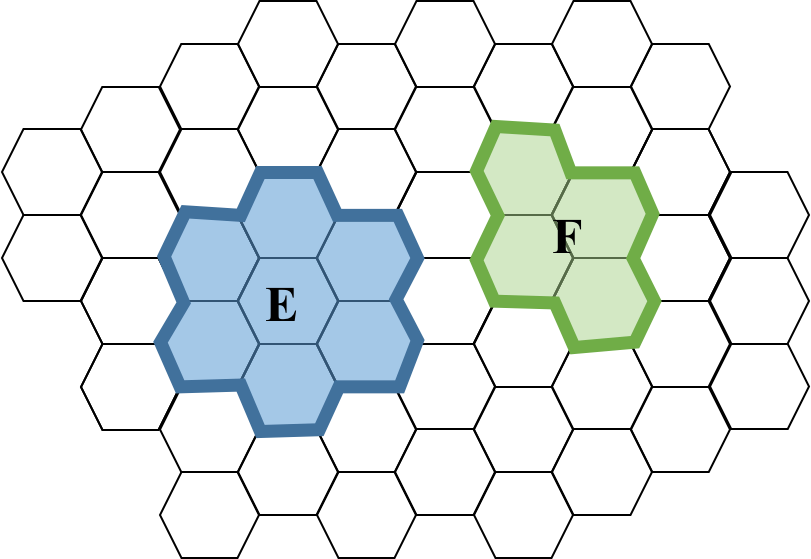
If two events: , are mutually exclusive then the probability of or occurring is:
\[P(E \text{ or } F) = P(E) + P(F)\]For n mutually exclusive events:
\[P(E_1 \text{ or } E_2 \text{ or } \dots \text{ or } E_n) = P(E_1) + P(E_2) + \dots + P(E_n) = \sum_{i=1}^n P(E_i)\]Probability of and
source4
Two events, say $E$ and $F$, written $P(E \text { and } F)$, is the probability of both events happening. You might see equivalent notations $P(E,F)$, $P(EF)$ and $P(E \cap F)$, to mean the probability of and.
Definition: Probability of and for independent events. If two events: $E$, $F$ are independent then the probability of $E$ and $F$ occurring is:
\[P(E \text { and } F) = P(E) \cdot P(F)\]Conditional Probability
source5
In English, a conditional probability states “what is the chance of an event $E$ happening given that I have already observed some other event $F$ “. It is a critical idea in machine learning and probability.

The probability of E given that (aka conditioned on) event F already happened:
Written as: $P(E \mid F)$
Means: “P(E, given F already observed)”
Notations
| Meaning | Common notation | Also seen | Description |
|---|---|---|---|
| AND | $P(E \cap F)$ | $P(E,F)$, $P(EF)$, $P(E \text{ and } F)$ | Probability that both $E$ and $F$ occur |
| OR | $P(E \cup F)$ | $P(E+F)$, $P(E \text{ or } F)$ | Probability that at least one of $E,F$ occurs |
| Condition | $P(E \mid F)$ | $P(E\mid F)$, $P(E\text{ given }F)$ | Probability of $E$, given that $F$ occurred |
Bayes Theorem
Bayes’ theorem provides a way to convert a conditional probability from one direction, say $P(E \mid F)$, $P(F \mid E)$ to the other direction.